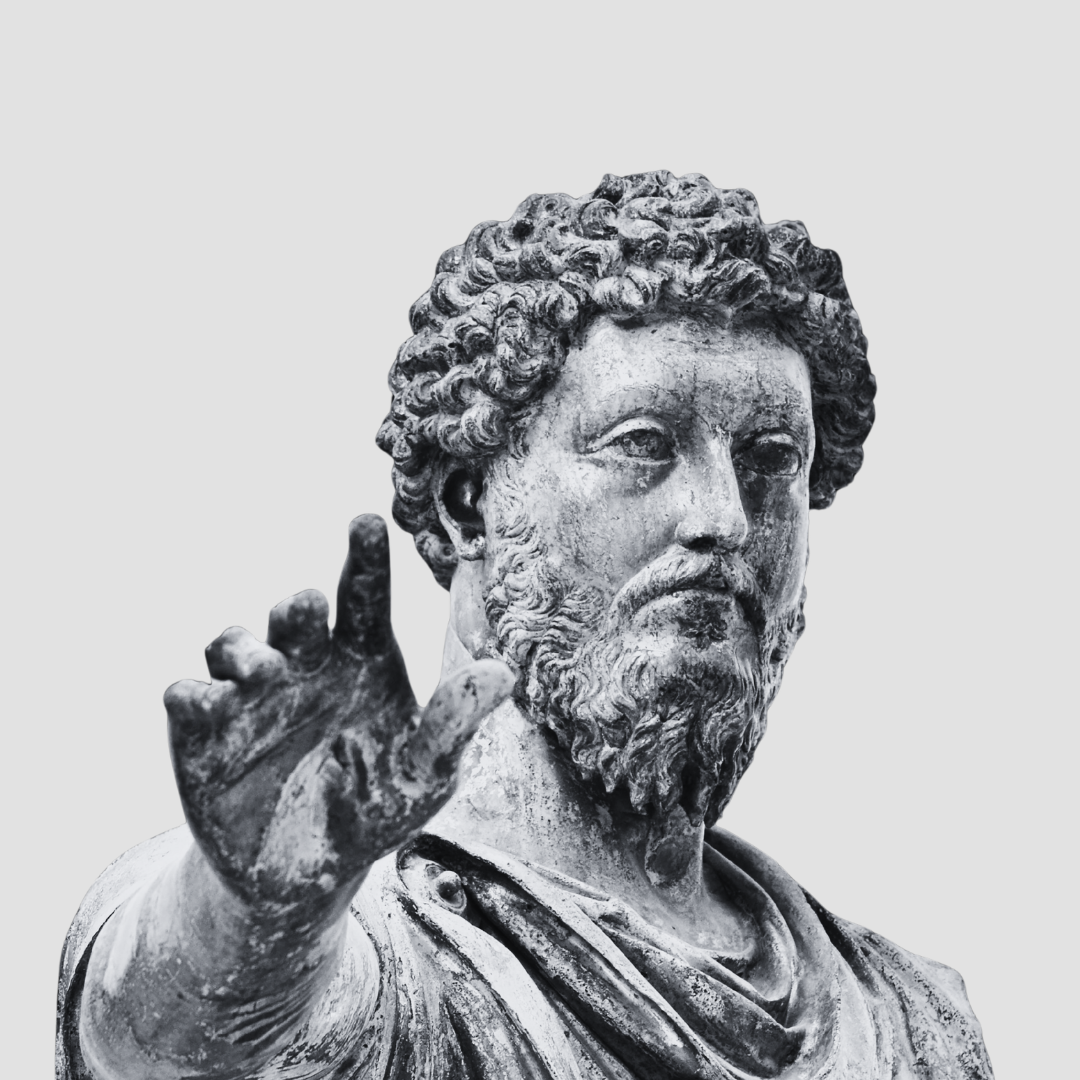
The Emperor Who Ruled Himself
To understand the enduring legacy of Marcus Aurelius, one must look through the eyes of the men who actually watched him rule. Two of the era’s most vital chroniclers — Herodian and Cassius Dio — viewed the “Philosopher King” not just as a head of state, but as a rare anomaly of moral consistency.
Herodian of Antioch (c. 170–240 CE), a Greek historian and Roman civil servant, famously observed in his History of the Empire that Marcus was unique because he didn’t just talk about philosophy; he lived it:
“Alone of the emperors, he gave proof of his learning not by mere words or knowledge of philosophical doctrines, but by his blameless character and temperate way of life.” – Herodian
This sentiment was echoed by Cassius Dio (c. 163–235 CE), a high-ranking Roman official and consul whose 80-book Roman History serves as a definitive account of the Empire’s shift from stability to crisis. Dio went even further, asserting that:
“In addition to possessing all the other virtues, he ruled better than any others who had ever been in any position of power.” – Cassius
Praise like this is easy to dismiss as the exaggeration of loyal chroniclers. Yet in Marcus, the rare alignment of philosophy and authority seems to have been real.
Together, these historians paint a portrait of a leader who defined an era — and whose discipline remains a blueprint for character today.
An Unlikely Beginning
Born on April 26, 121, as Marcus Catilius Severus Annius Verus, there was little to suggest he would one day command the vast machinery of Rome. Fate, however, had placed him within sight of power.
The reigning emperor, Hadrian, took notice of the young Marcus early on. Impressed by his seriousness and academic promise, Hadrian nicknamed him Verissimus — “the truest one” — a subtle play on his family name, Verus. Whether it was discipline, intellect, or quiet steadiness that captured Hadrian’s attention, we cannot say. But by the time Marcus was seventeen, the emperor had begun shaping a succession that would alter Roman history.
On February 25, 138, Hadrian adopted Antoninus Pius, stipulating that Antoninus in turn adopt Marcus. It was a calculated plan: a seasoned ruler would guide the empire briefly before handing it to the promising young heir. Yet history rarely obeys projections. Antoninus did not reign for five years — but for twenty-three.
Marcus waited. He studied. He prepared.
The Weight of the Empire
In 161, upon Antoninus’ death, Marcus ascended to the throne. His reign would last nearly two decades and would test every principle he claimed to hold.
He faced prolonged conflict with the Parthian Empire, mounting pressure from Germanic tribes along the northern frontiers, internal unrest, the rapid spread of Christianity, and a devastating plague that swept through the population. The throne he inherited was not cushioned by peace — it was surrounded by crisis.
Yet later historians, including Edward Gibbon, would reflect that during his rule — often considered the last chapter of the “Five Good Emperors” — Rome was governed by absolute power guided by wisdom and virtue.
Wisdom and virtue: this is the distinction.
The Private Discipline Behind Public Power
Most rulers leave behind monuments, decrees, and battle accounts. Marcus left something more intimate.
In what we now call the Meditations, he recorded private reflections never meant for publication. There, the most powerful man in the known world reminds himself — again and again — to be patient. To be just. To resist anger. To meet insult without retaliation. To accept death without fear. To subordinate ego to duty.
This is what makes Marcus extraordinary. Not that he ruled — but that he struggled inwardly to rule himself.
Stoicism on the Throne
For Marcus, Stoicism was not an abstract system of thought. It was a daily discipline. A framework for enduring uncertainty. A method for restraining impulse amid flattery, crisis, and temptation.
He did not claim to be perfect. His writings show effort, correction, recommitment. They reveal a ruler who understood that authority magnifies weakness unless anchored by principle.
Marcus Aurelius stands apart not because he possessed power — but because he treated power as a responsibility to character.
In an age crowded with ambition and spectacle, his example remains quietly radical: govern yourself first.
Leave a Reply